The Fundamental Tension of Information Sharing
In the architecture of modern enterprise intelligence, we are increasingly confronted by a structural conflict: the drive for collective intelligence versus the mandate for data sovereignty. Within an IT/AI Stack, "Open Information Sharing" — or Superdistribution — serves as a high-velocity engine for organizational learning. However, this same mechanism introduces a catastrophic strategic vulnerability. From an information security standpoint, the very fluidity that facilitates learning simultaneously demolishes confidentiality.
The trade-off is absolute, as underscored by the source context:
This tension is not a failure of policy, but a symptom of the underlying geometry of team structures. As we scale the human element, the risk profile shifts from manageable to uncontainable.
The Geometry of Communication: Nodes vs. Lines
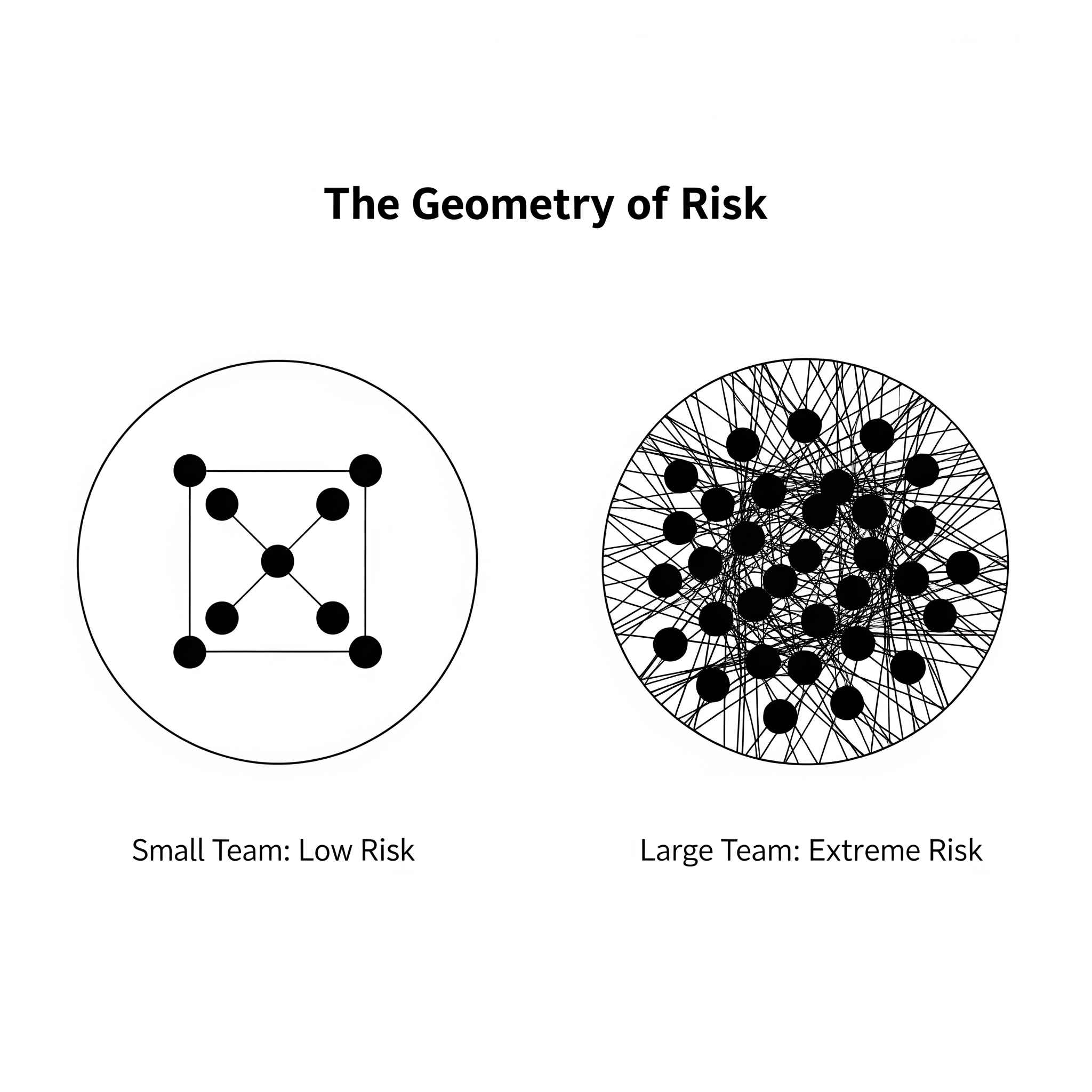
Maintaining confidentiality in a growing environment is a mathematical impossibility without structural intervention. The relationship between the number of participants (nodes) and the potential communication paths (lines) is non-linear. As we add personnel, we are not just adding voices; we are facilitating vector proliferation across an exponentially expanding attack surface.
The Exponential Growth of Complexity
| Team Size (Nodes) | Communication Paths (Lines) | Complexity & Security Impact |
|---|---|---|
| 3 People | 3 Lines | Minimal: Information is easily compartmentalized. |
| 6 People | 15 Lines | Moderate: Fivefold complexity increase over a 3-person node. |
| 12 People | 66 Lines | Severe: Attack surface exceeds manual oversight capabilities. |
Synthesis: For the Strategic Architect, the "so what" is clear: linear growth in team size results in exponential loss of control. This mathematical reality dictates that confidentiality cannot be maintained through trust-based models once a certain node-threshold is crossed. Because this complexity makes universal control impossible at scale, we must choose which state we are optimizing for; we cannot mathematically achieve both maximum learning and maximum security.
The Functional Conflict: Learning vs. Confidentiality
The geometry of these communication lines forces every IT and AI environment into one of two mutually exclusive states.
| State | Strategic Outcome | Architectural Impact |
|---|---|---|
| State 1: High Information Density | Optimized for Learning | High-velocity sharing creates a rich environment for collective intelligence but zero-containment. |
| State 2: High Communication Complexity | Deficient for Confidentiality | The density of interaction paths creates too many leak points, making "need-to-know" protocols unenforceable. |
Navigating this conflict requires the implementation of specific "Strategic Guardrails" to enforce boundaries within the AI deployment.
Strategic Guardrails for Information Control
To secure a modern IT / AI Stack, architects must implement two fundamental rules. These rules function as a "kill switch" for the complexity described above, where Rule 1 acts as the sensor and Rule 2 as the actuator.
1. Traceability
- The Sensor: There must be total visibility into data sources and the specific working methods of the AI model.
- Access Governance: Strict auditing of who has access to the model, who can view the underlying data, and who possesses the authority to influence the system's parameters or outputs.
2. Process Management
- The Actuator: You must actively tend the stack. This is not a static setup but an ongoing requirement to maintain the environment so that it remains under administrative control.
- Termination Power: Architects must retain the capacity to terminate processes immediately or delete specific results/data sets if the system deviates from the contained environment.
By adhering to these rules, the architect ensures that even a sophisticated AI stack remains auditable and destructible at any point in its lifecycle.
The Strategy of Selective Involvement
The definitive solution to the scale complexity paradox is a strategic pivot from "General Purpose" systems to Single-Purpose AI deployed in contained environments. We must move away from the unmanaged web of communication toward selective involvement and dedicated workflows.
Securing the future of high-speed information sharing rests on three pillars:
- Selective Human Involvement: Restricting the "node count" to the absolute minimum required for the objective.
- Fixed, Programmed Workflow Plans: Replacing spontaneous, open-ended interactions with rigid, pre-defined sequences of operation.
- Granular Telemetry (State-Level Monitoring): Implementing control processes at every level of the workflow — ensuring real-time auditability and irregularity detection at every node.
Final Insight: The safest response to the catastrophic risks of large-scale sharing is the enforcement of single-purpose environments. By narrowing the focus and the participants, we transform a chaotic web into a controlled, auditable pipeline.